
'Worthy of preservation'
Historic properties in Alamance County invite conversation, commemoration
Article & visuals by Sarah T. Moore
March 19, 2026
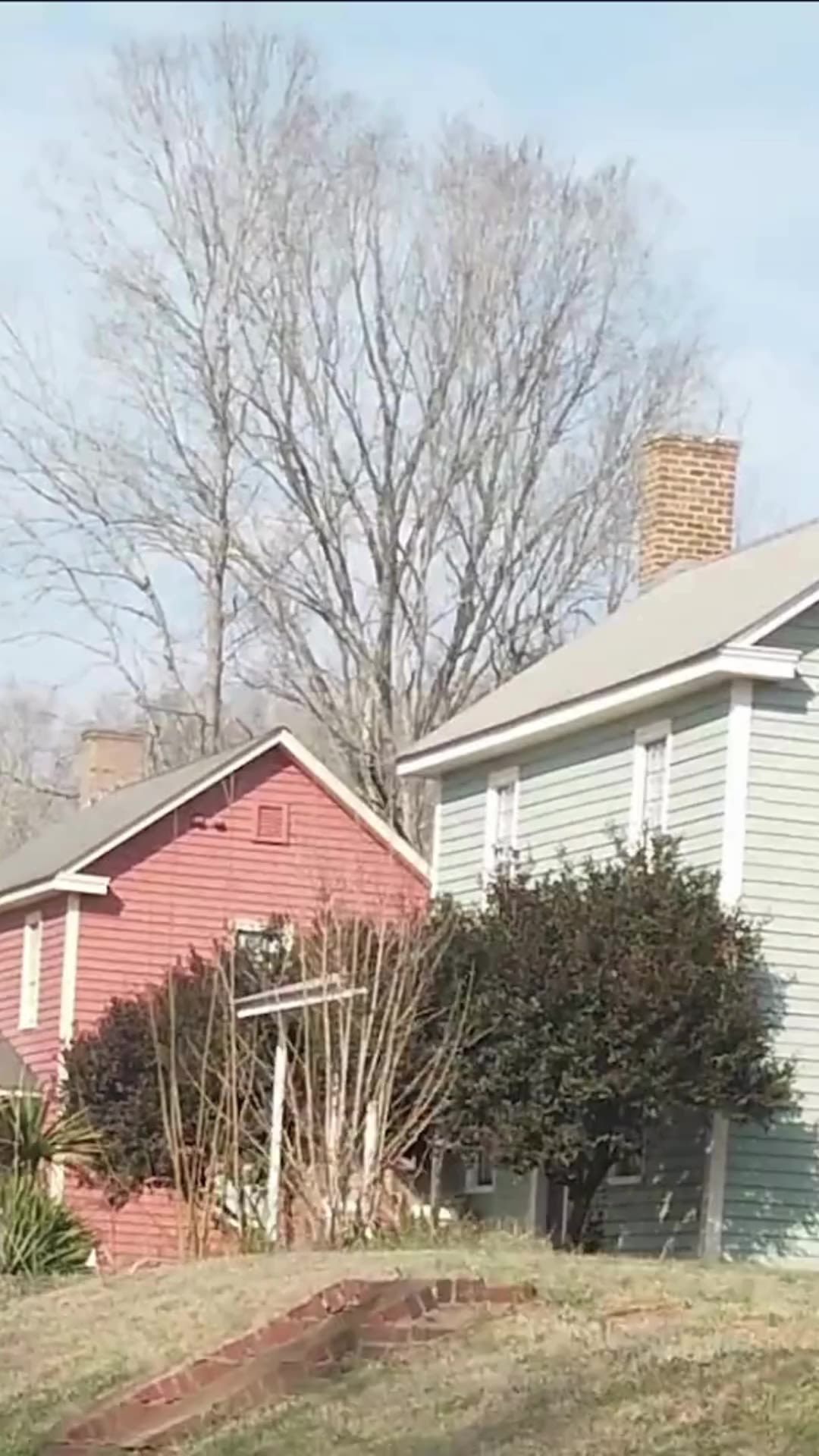

For Tom Cowan, looking at a house is like reading a book. Houses are “visual literature,” he said. And Glencoe Mill Village has great literature.
The siding, the windows, the doors, the roofs, the porches: these are all motifs that help tell the story of Glencoe, a colorful collection of 1880s mill village houses.
It’s not an accident that these houses still retain their distinct late-nineteenth century architecture more than 140 years later. The Glencoe Mill Village is a locally designated historic district, meaning that residents have restrictions on altering the exteriors of the properties.
Tom and his wife, Lynn, have lived in Glencoe for over 25 years. Lynn said she loves living in a historic house. She cares about the history, the maintenance and her neighbors, which have developed into a community of preservation enthusiasts.
“The people that end up investing in these properties, they’re there for a reason,” Lynn said. “And if they're not, they don’t last long. You live in one a couple years and you move on.”

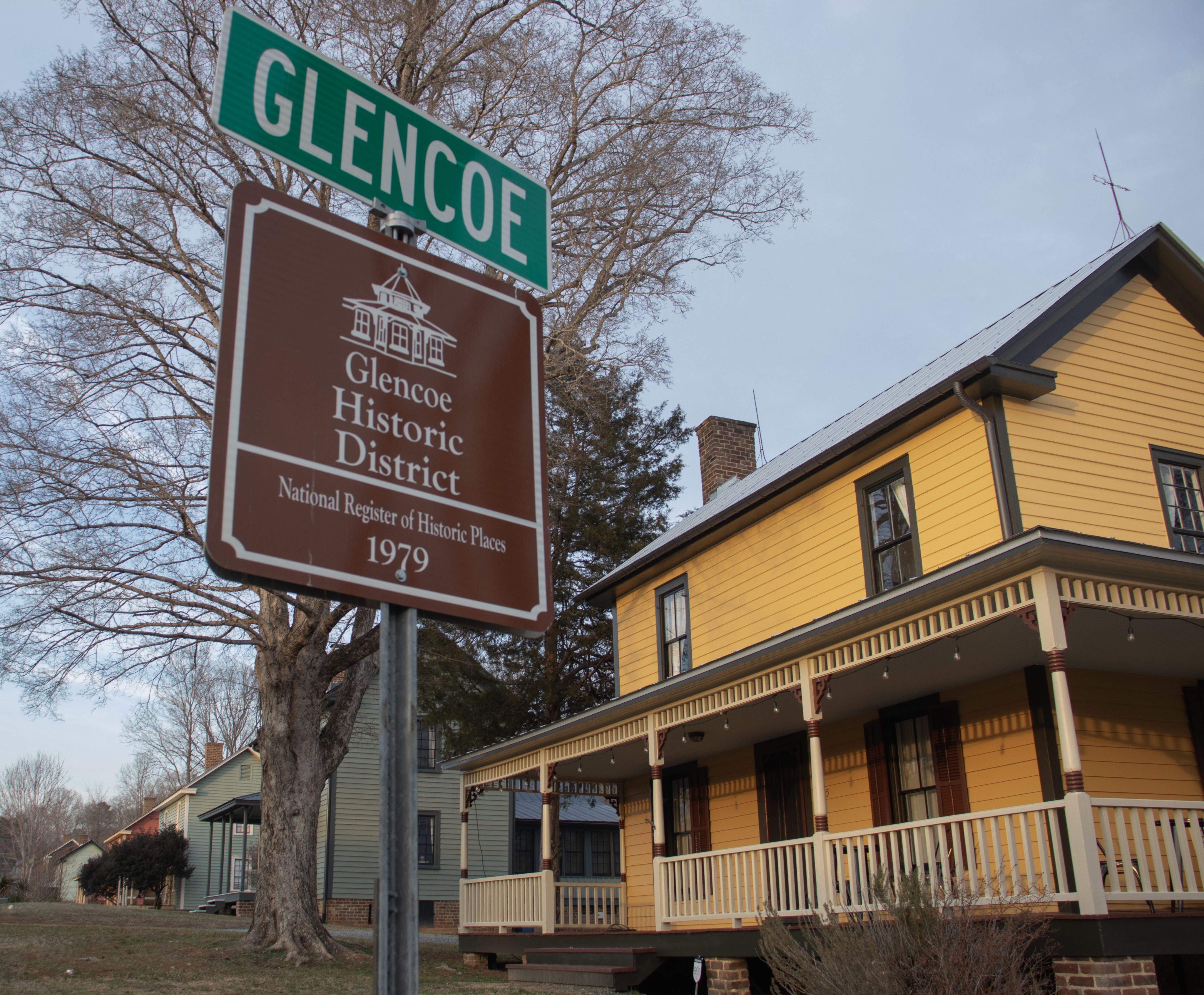
Glencoe Mill Village is one of 20 nationally designated historic districts in Alamance County. It is also a locally registered district in Burlington — meaning that residents have restrictions on altering the exteriors of the properties. The mill village has about 40 properties where mill workers and their families would have lived during the textile mill’s operation.
Glencoe Mill Village is one of 20 nationally designated historic districts in Alamance County. It is also a locally registered district in Burlington — meaning that residents have restrictions on altering the exteriors of the properties. The mill village has about 40 properties where mill workers and their families would have lived during the textile mill’s operation.
Glencoe Mill Village is one of two locally registered historic districts. While it’s technically outside of the city Burlington, it’s regulated by the city’s Historic Preservation Commission.
The commission reviews plans for the material and design elements to ensure they are appropriate to the building’s original architecture.
Chairman Brian Pennington lives in a historic district himself and said he believes retaining a place’s “historic character” is essential to its identity.
“History is what makes us who we are. Structures, properties, places are sites where those identities are constructed and retaining this historic character of neighborhoods and properties ensures that we are always in dialogue with our past and know who we are,” Pennington said.
Pennington said he views the districts as entry-points to conversations about Burlington’s past.
Each house is a vessel for stories of former Burlington residents.
Burlington HPC Chairman Brian Pennington explores significance of local historic districts.
Lynn grew up in Alamance County and remembers the stories her mother would tell her about the mill village. Those stories are part of why Lynn was interested in obtaining and preserving her Glencoe property.
While the stories may be remembered through word of mouth, it’s still important to document them and ensure they can continue to be told.
Burlington Mayor Beth Kennett didn’t grow up in the area and had never heard the stories that many long-time residents are familiar with.
“Those stories weren’t handed down to me,” Kennett said.
Kennett said asking questions about the historic properties helped her learn more about the area’s overall history: from its agricultural roots to its role as railroad repair stop then its industrialization through textile mills.
Which stories get told
There’s a wide range of conversations sparked by historic districts. Pennington said there is sometimes tension when people view the districts as celebrating the results of racist, classist social systems.
Many of the historic houses in Burlington, Pennington said, were built by formerly enslaved people who had harsh labor conditions.
“Retaining those properties also allows us to tell those stories,” Pennington said. “Historic preservation is not just about celebrating the people who had the power and privilege to build beautiful homes and city blocks 100 years ago, but they're also contacts for us to tell the stories of all the people.”
“Historic preservation is not just about celebrating the people who had the power and privilege to build beautiful homes and city blocks 100 years ago, but they're also contacts for us to tell the stories of all the people."
Maintaining historic character
Tom and Lynn have owned their house in Glencoe Mill Village since the 1990s. The building has changed a lot since then, but it still retains its “historic character.”
When the couple wants to change the exterior of their house, such as the addition they built a few years ago, they have to get approval from Burlington’s Historic Properties Commission to ensure their work will meet standards of historical "appropriateness" for their 19th-century home.
Glencoe Mill Village, in particular, has additional restrictions. All homeowners must agree to the district's covenants — a 46-page document with standards for property alterations.
After going through the motions, Tom and Lynn’s renovation plans were approved and the couple has since added a dining room, living room and office to their house.
The original siding on Tom and Lynn’s Glencoe house is 146-year-old old growth heart pine. It was important to them — and the commission — that their addition looked like it belonged with the rest of the building. The same materials aren’t as available anymore, so Tom said they had to find something that looked cohesive and could be maintained.
Heart pine, Tom said, will last centuries as long as it’s taken care of. For Tom and Lynn, that means painting their house every seven years.
The maintenance of historic properties is one reason some people avoid them, Lynn said. But to her, it’s a benefit. Unlike with a newer house, the maintenance of Tom and Lynn’s 1880s Glencoe home is, for the most part, predictable. They know what to look for.
The materials — such as the ones for their windows, siding and floors — have been around long enough that it’s well-documented how they change over time and how they should be taken care of. Lynn said newer construction tends to be designed to disguise maintenance needs until it’s too late. Some materials, such as vinyl, are incredibly difficult to maintain and are designed to be replaced rather than repaired, Lynn said.
The West Davis Street-Fountain Place Historic District is a "superb display" of houses from the late-19th century to the early-20th century.
Another key difference between the construction of many historic and newer houses is that historic houses are easier to take apart — particularly those built in the era of mail-order homes. Lynn said this makes it easier to repair one aspect of the house at a time.
Building on their passion of caring for historic properties, Tom — whose background is in public history — and Lynn — who has degrees in interior architecture — decided to start their own LLC where they work with property owners on their old buildings.

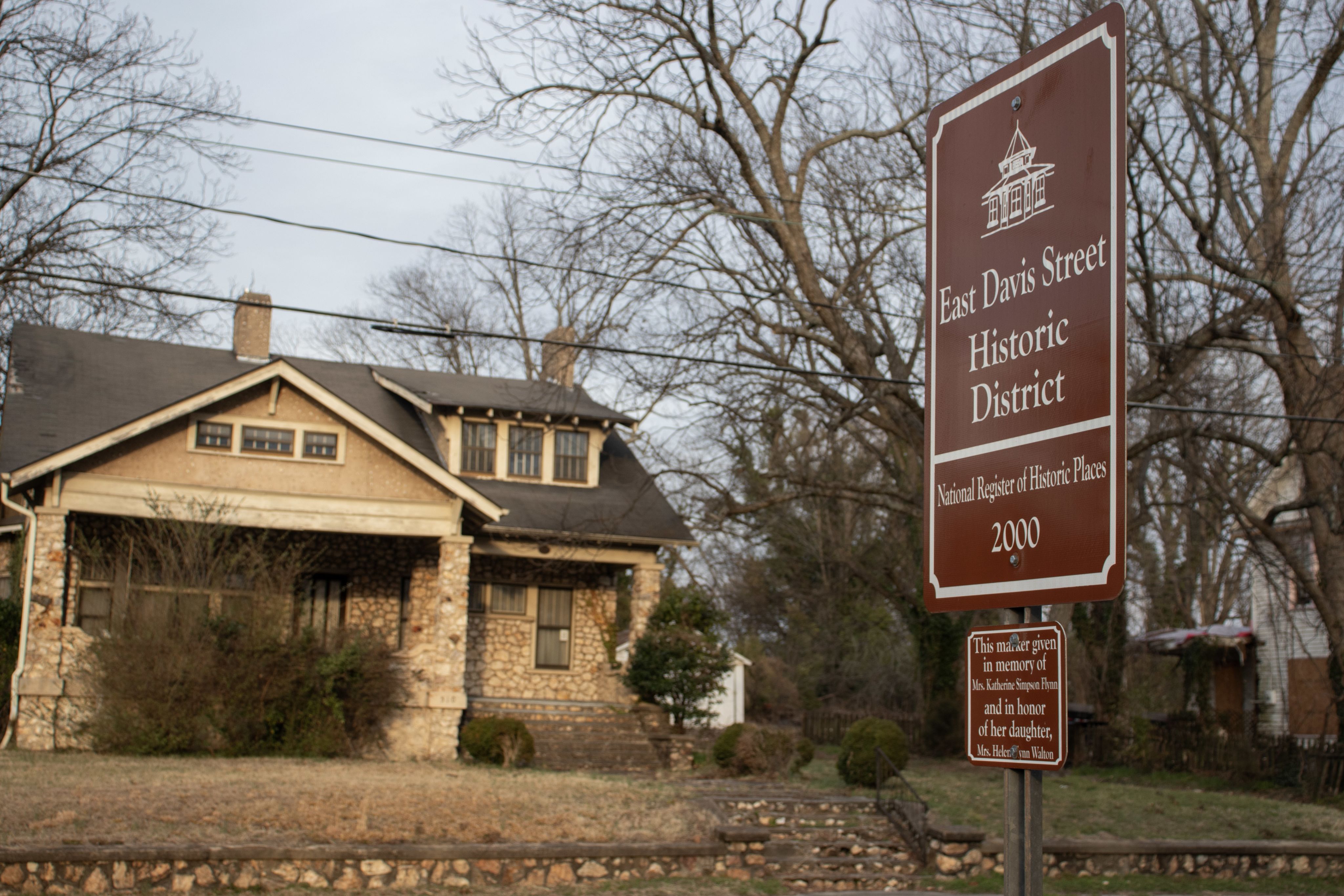
East Davis Street Historic District is listed on the National Register of Historic Places, but it not locally regulated by Burlington's Historic Preservation Commission. Still, Tom and Lynn Cowan's historic preservation business Lyncoe has done several projects in the district.
East Davis Street Historic District is listed on the National Register of Historic Places, but it not locally regulated by Burlington's Historic Preservation Commission. Still, Tom and Lynn Cowan's historic preservation business Lyncoe has done several projects in the district.
They teach. The couple will give owners guidance on how to repair their window sashes, how to maintain wood siding, or how to fix their doors. While some property owners will follow the couple’s instructions and then maintain the building themselves, Tom said he often finds himself contracted for this work. He even repaired Pennington’s window sashes a few years ago.
They build. Lynn brings her expertise to drafting blueprints of outbuildings, additions, interior renovations and more. Once a plan is approved, Tom leads the construction with his practical skillsets. The office they built onto their Glencoe home is filled with neatly organized blueprints for upcoming projects across the state.
They demolish. It’s not a typical demolition though. Tom carefully takes apart the building, salvaging any materials he can. He’ll reuse them for other projects. It’s particularly exciting, he said, when he is able to save wood. Tom recently deconstructed a tobacco barn and is now repurposing that wood in a repair project for a different tobacco barn.
When he doesn’t have a project in mind with the materials, he said he often donates them to the local salvage shop, conveniently at the entrance of Glencoe Mill Village.
Tom and Lynn said they try to dissuade property owners from destroying a building entirely, but they aren’t always successful.
Before the rows of colorful houses in the Glencoe Mill Village Historic District, there’s a World War II Quonset hut owned by local nonprofit Preservation Alamance. Inside the metal structure is an array of materials, appliances, doors, light fixtures, decorations and more that might otherwise end up in a landfill. Tom Cowan is on the board of preservation Alamance and helps run the salvage shop.
Registration isn’t regulation
Not all buildings will survive. It’s a truth those passionate about preservation have to face. Whether the building was neglected for too long, was significantly impacted by a natural disaster or the property owner is simply insistent on taking it down, Tom and Lynn have taken apart several buildings since they began their business.
It’s a popular misconception that owning a registered historic building means it can’t be torn down or that the home owners have little agency over changing the building.
While buildings in Burlington’s two local historic districts are regulated by the Historic Preservation Commission, this local designation is separate from the national designation many people associate with historic buildings.
The United States Department of the Interior, part of the National Parks Service, has maintained the National Register of Historic Places across the United States and its territories since 1966. It's described on the NPS website as the official list of the nation's "historic places worthy of preservation." Individuals, communities or organizations are able to nominate a property for designation.
Sherry Frear, chief and deputy keeper of the National Register of Historic Places program and National Historic Landmarks program, was unavailable for an interview, but wrote in a statement that each nomination is reviewed by NPS historians, and that rejections are rare.
“Listing in the National Register is a deliberative, collaborative process among local, state, and federal participants.” Frear wrote.
About 90% of nominations are listed and being listed does not impose federal restrictions on residential property owners, Frear wrote.
“They can still renovate or even demolish their property,” Frear wrote.
Alamance county has 72 nationally registered historic places, which includes 20 districts in addition to individual buildings, sites and structures.
While the register was created in the ’60s, there was an increase in nominations in the 1980s.
Molly Whitlatch, president of local nonprofit Preservation Alamance, said preserving historic buildings can shape how the county remembers itself.
“It tells the story of that specific community and what happened there, and what their history was, what their culture was,” Whitlatch said.
Whitlatch said there was a national movement to recognize and retain historic places that gained traction in the ’80s. It’s a movement Tom and Lynn were heavily involved in when they advocated for Glencoe Mill Village’s national designation, which it received in 1979.
However, Whitlatch said that movement has dwindled over time.
“There's been a loss of momentum,” Whitlatch said. “If additional protections aren't added then I think we're at risk of losing a lot.”
Burlington’s West Davis Street-Fountain Place historic district did not receive its local designation until some of the houses had already lost many of their historically significant elements.
Real estate agent and historic district resident Faith Grant talks about how the West Davis Street-Fountain Place Historic District has changed.
Whitlatch said she views the buildings as “artifacts” that honor the people who lived or worked there and the events that happened there.
“We honor those in different ways, depending on what those are. Sometimes, we celebrate them. Sometimes, we mourn them,” Whitlatch said. “It's just a different experience if you can't stand in the space.”
Preservation Alamance works with property owners to maintain their properties. They host maintenance classes, manage the salvage shop, host annual house tour events, and even offer grants for renovation projects. A part of her work, Whitlatch said, is helping property owners navigate the process of getting their renovations approved by the city of Burlington.
When there are historic property restrictions, they typically come from the municipality, county or state governments, not NPS.
Molly Whitlatch is a founding member of Preservation Alamance — then known as Preservation Burlington.
Step Inside
Even when the exterior of a building is regulated, such as in Burlington’s locally designated historic districts, homeowners have control over the interior. This is where Lynn said she sees the most opportunity for preservation.
Living in a historic district does not mean living a historic lifestyle.
This, she said, is the key difference between restoration and preservation. While a restoration project seeks to return the house as close to its original state as possible, preservation projects ensure the house can continue to have value in the market.
Tom and Lynn’s 1880s house has full plumbing, electricity, air conditioning, modern kitchen appliances and a range of other innovations that did not exist when the mill village was built.
“The important thing to think about is how to incorporate modern amenities in a way that doesn’t impact the historic structure and is reversible,” Lynn said.
Many of the blueprints in Lynn’s office are about adding HVAC systems to old buildings.
“If you don’t make a house so people can live in it with the modern amenities, it’s not going to survive,” Lynn said. “That, right there, is the crux of it. It has to continue to evolve to fit people’s lifestyles to survive.”
Preservation Alamance founding member and real estate agent Faith Grant said she often finds herself reminding clients that historic houses can have modern amenities.
Whitlatch said she wants to challenge the idea that it is more expensive to maintain an older house than a newer one.
“In certain circumstances, that may be true, but the materials that older houses were built with to begin with seem to last a lot longer and are more durable,” Whitlatch said. “You can't fix a vinyl window once it's broken. You have to then replace it again.”
While it can be less expensive to maintain a historic house, these properties may need more than maintenance if they haven’t been properly taken care of.
Roll Construction CEO, Jensen Roll, said historic houses often require complex, expensive projects upfront that can make these houses feel unapproachable to potential buyers. Roll said some historic houses he’s worked on have had lead-based paint, asbestos, knot-and-tube wiring or unstable foundations built directly onto red clay, which shifts over time.
“A lot of these homes have been moving,” Roll said. “When we come in with our newer building science, we have to be aware of the fact that these homes that are built a long time ago are living, breathing ecosystems.”
For Roll, historic preservation projects are not just about accuracy or cohesion, but also safety.
“Working in those homes is a lot more difficult but done well it can be extremely rewarding,” Roll said.
Even less extensive projects, such as fixing flooring can be more difficult in historic homes, Roll said.
“We can’t go to Lowe’s or Home Depot and find options to match flooring like that,” Roll said.
Downtown Burlington's locally designated historic district spans sections of West Davis Street, Front Street and Fountain Place.
Grant works with many historic houses, she even helped Whitlatch buy her home in Graham. Whitlatch said she’s still researching the house’s previous owners and looking at what work has been done to the house in the past.
“It's not just a house,” Whitlatch said. “There's a whole story there.”
But not everyone who buys a historic house is a history enthusiast like Whitlatch. Grant said many of her clients want to live close to a downtown area, which can put the historic houses near downtown Graham, Burlington and Mebane on their radar.
“I just hope that people understand that once these buildings are gone, they're gone,” Whitlatch said. “We can't get them back.”
When her clients are looking at houses in Burlington’s local historic districts, she said the regulations may be daunting — especially for potential buyers who have never lived in a historic building.
“As long as you have an understanding of what the architectural style should look like and you read the guidelines, or get guidance from the city, it’s pretty straightforward,” Grant said.
I just hope that people understand that once these buildings are gone, they're gone.
A closer look at historic houses
1925 house on West Davis Street, Burlington

This house was originally owned by Howard Fogleman who worked for Sellers Hosiery Mills, according to the district's National Register of Historic Places nomination. Folgeman and his wife hosted events here, according to a newspaper article that said they decorated the living room and dining room with roses and sweetpeas. Photo courtesy of Faith Grant.
This house was originally owned by Howard Fogleman who worked for Sellers Hosiery Mills, according to the district's National Register of Historic Places nomination. Folgeman and his wife hosted events here, according to a newspaper article that said they decorated the living room and dining room with roses and sweetpeas. Photo courtesy of Faith Grant.
1915 house on West Front Street, Burlington

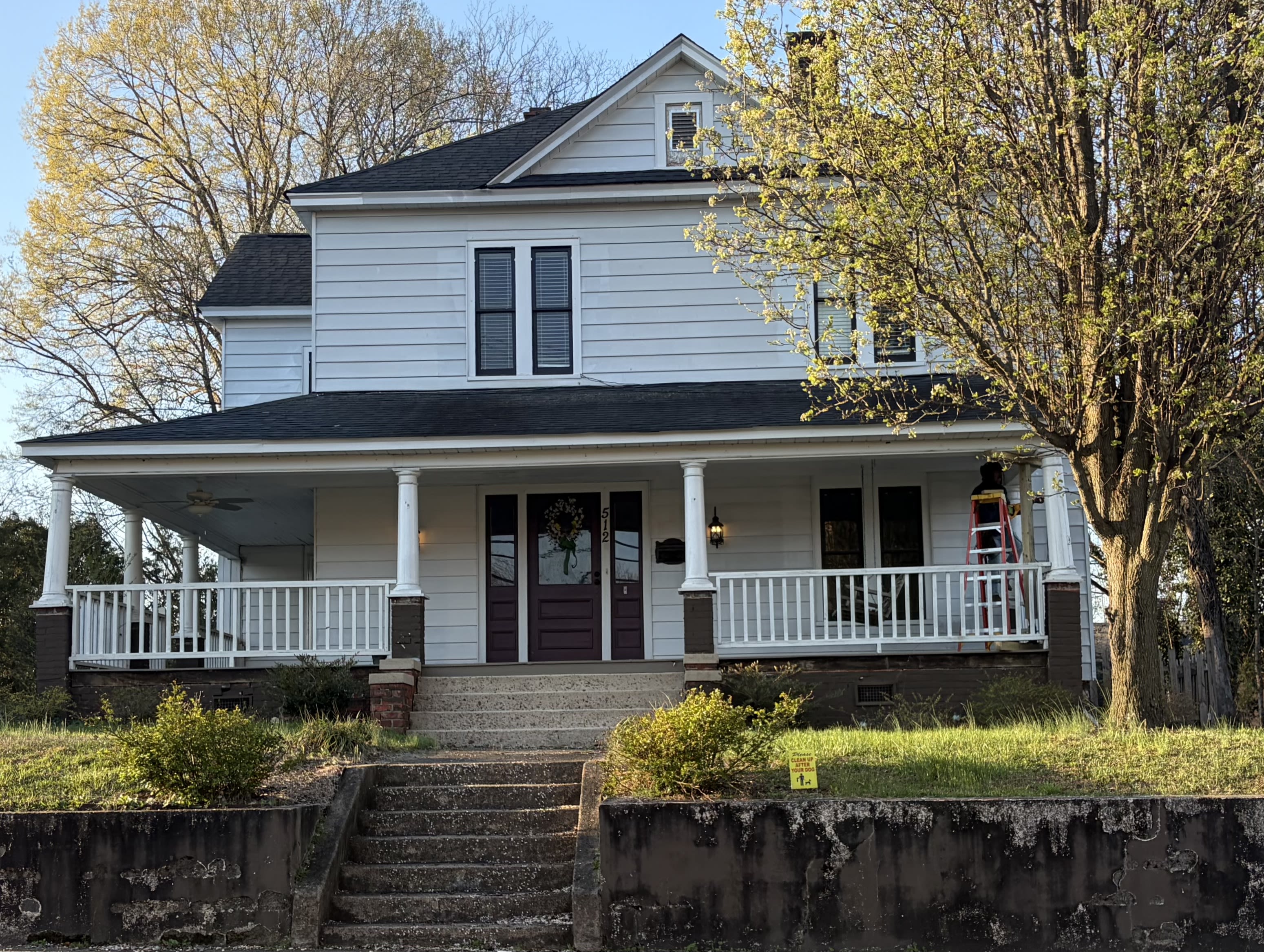
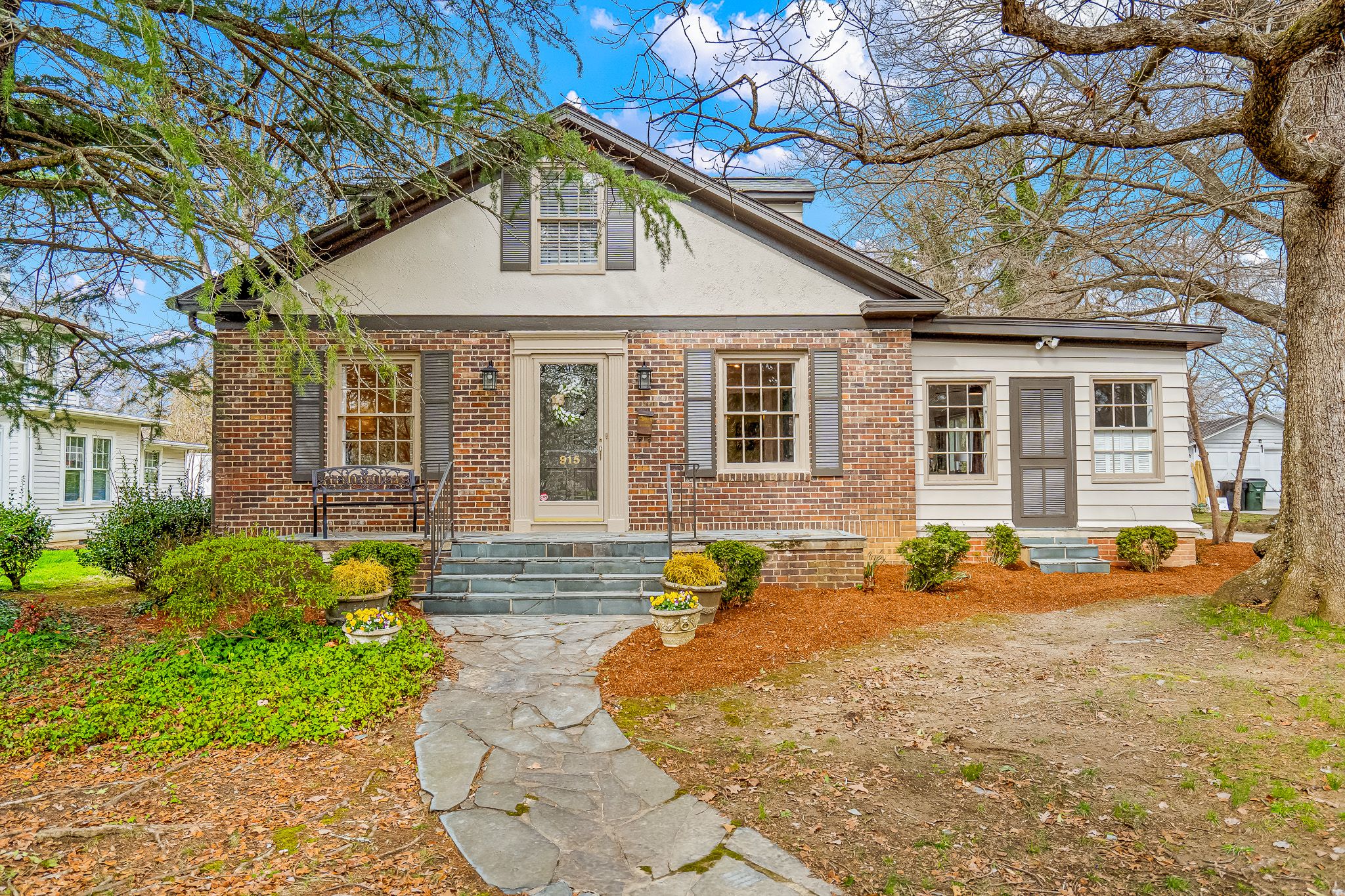
This house is currently being renovated. Since it's in a locally designated historic district, exterior modifications may need a Certificate of Appropriateness from the Burlington Historic Preservation Commission.
This house is currently being renovated. Since it's in a locally designated historic district, exterior modifications may need a Certificate of Appropriateness from the Burlington Historic Preservation Commission.
1900 house on Albright Avenue, Graham

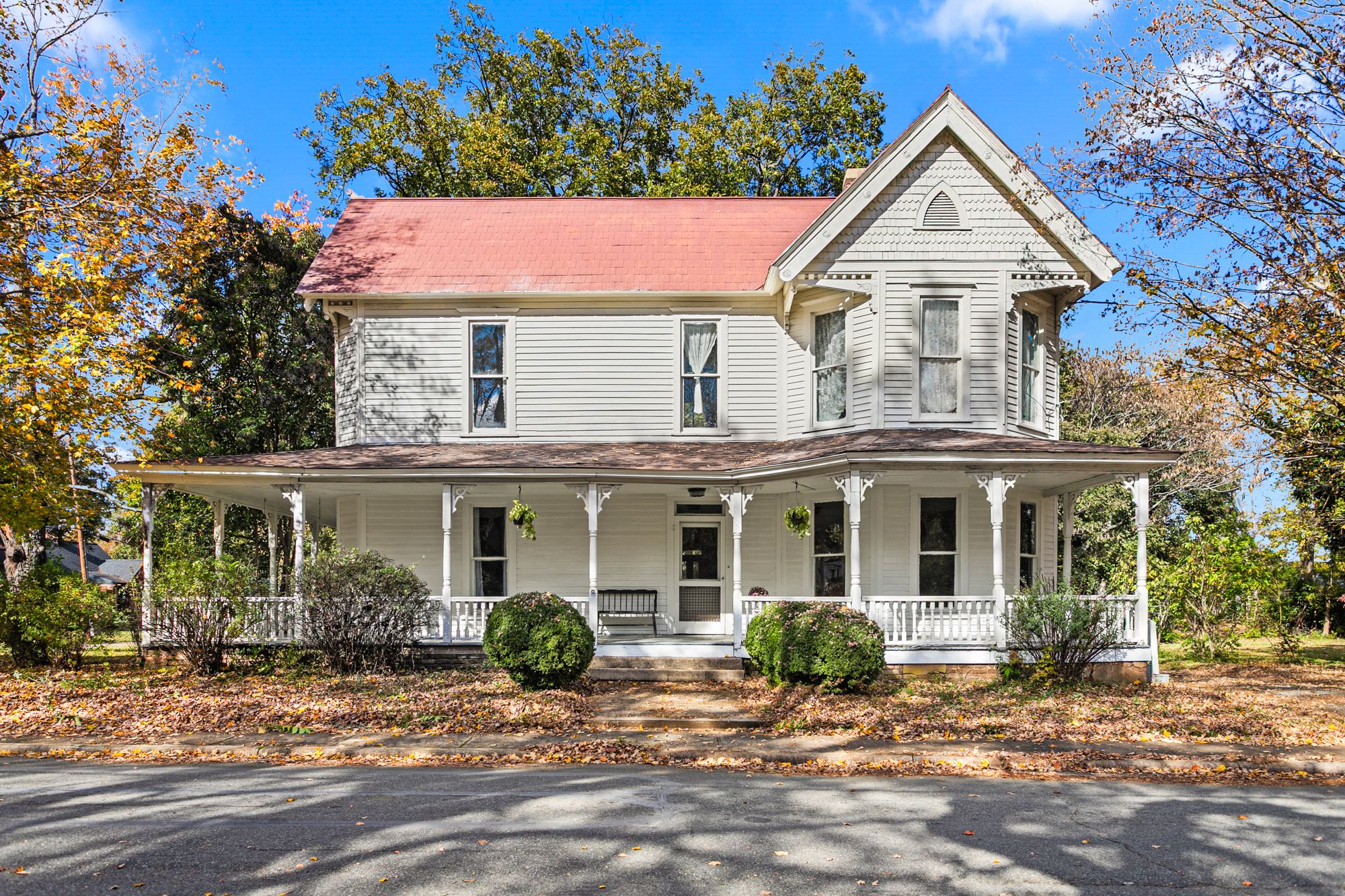
This house is in Graham's North Main Street Historic District, which is on the National Register of Historic Places. According to the register nomination, this house is one of the "most intact" examples of Queen Anne-style architecture. Many houses in this area belonged to businessmen, doctors or industrialists. This house, owned by a dentist, was no exception. Photo courtesy of Faith Grant
This house is in Graham's North Main Street Historic District, which is on the National Register of Historic Places. According to the register nomination, this house is one of the "most intact" examples of Queen Anne-style architecture. Many houses in this area belonged to businessmen, doctors or industrialists. This house, owned by a dentist, was no exception. Photo courtesy of Faith Grant
 Built with Shorthand