
‘We've forgotten about the conversation’: HIV/AIDS still hits the South as awareness fades
Commmunity reflects on shift in discussion, change in narrative
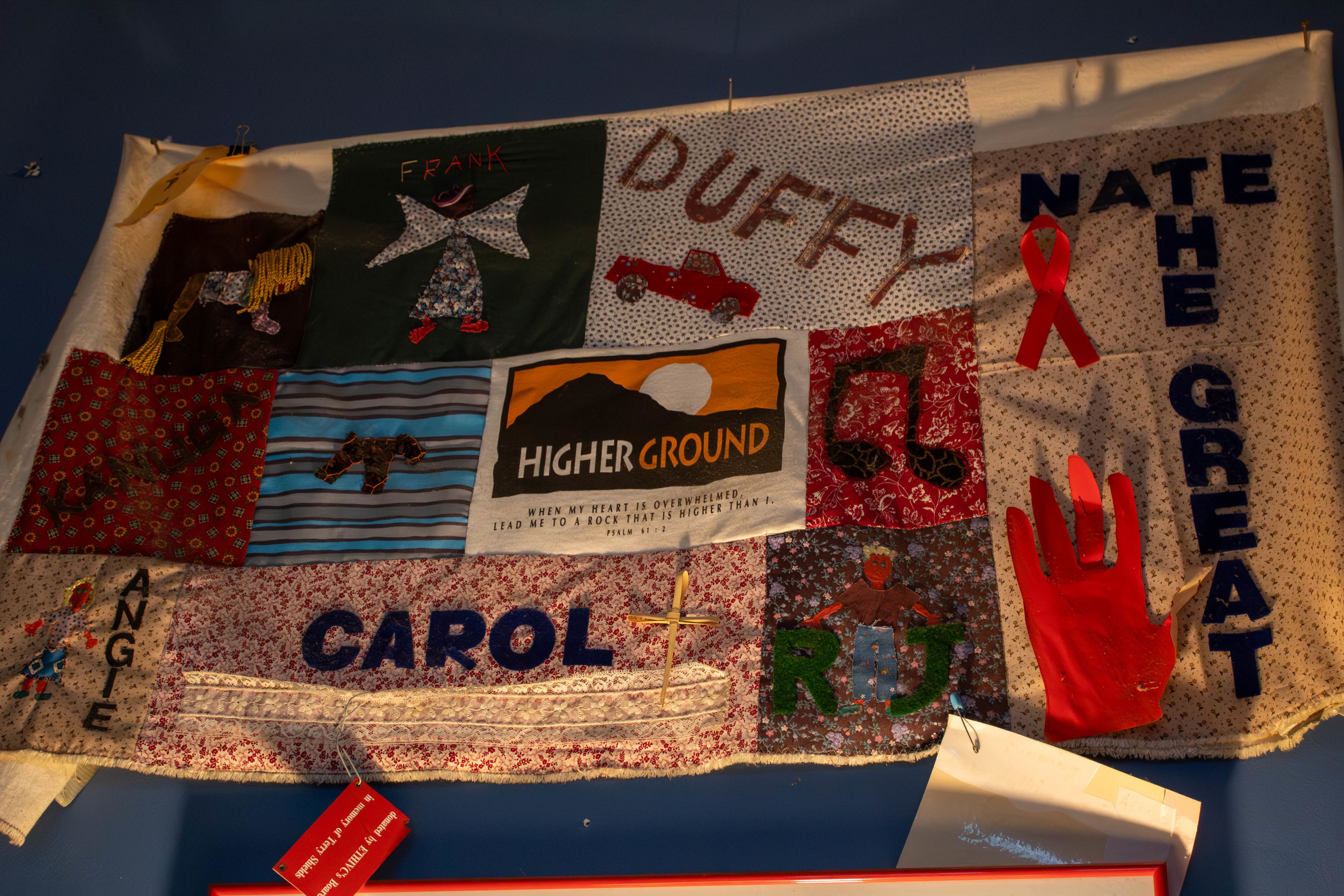

When Thomas Clodefelter walked into the American Red Cross in Lexington, North Carolina, he thought he would be making a difference.
“It was one of those things where I had the opportunity to go into the Red Cross and donate blood, and I didn’t think anything about it,” Clodefelter said. “I said, ‘Okay, I’m going to do something good.’ Went in and donated blood, didn’t think anything about it.”
But when he walked into the American Red Cross, little did he know what was flowing through his bloodstream.
“I had just completed a seven-year sentence from prison, maxed it out,” Clodefelter said. “I knew I hadn’t been involved with anybody sexually, pretty much thought I knew my status. But came to find out, six months later, a certified letter came in the mail. I had been exposed to HIV.”
Clodefelter had tested positive for human immunodeficiency virus in October 1990. HIV destroys infection-fighting CD4 cells in the immune system, according to the National Institutes of Health. The lack of CD4 cells can make it difficult for the body to fight off infections, illness and certain diseases. If HIV is left untreated, the infection can progress to acquired immunodeficiency syndrome — AIDS.

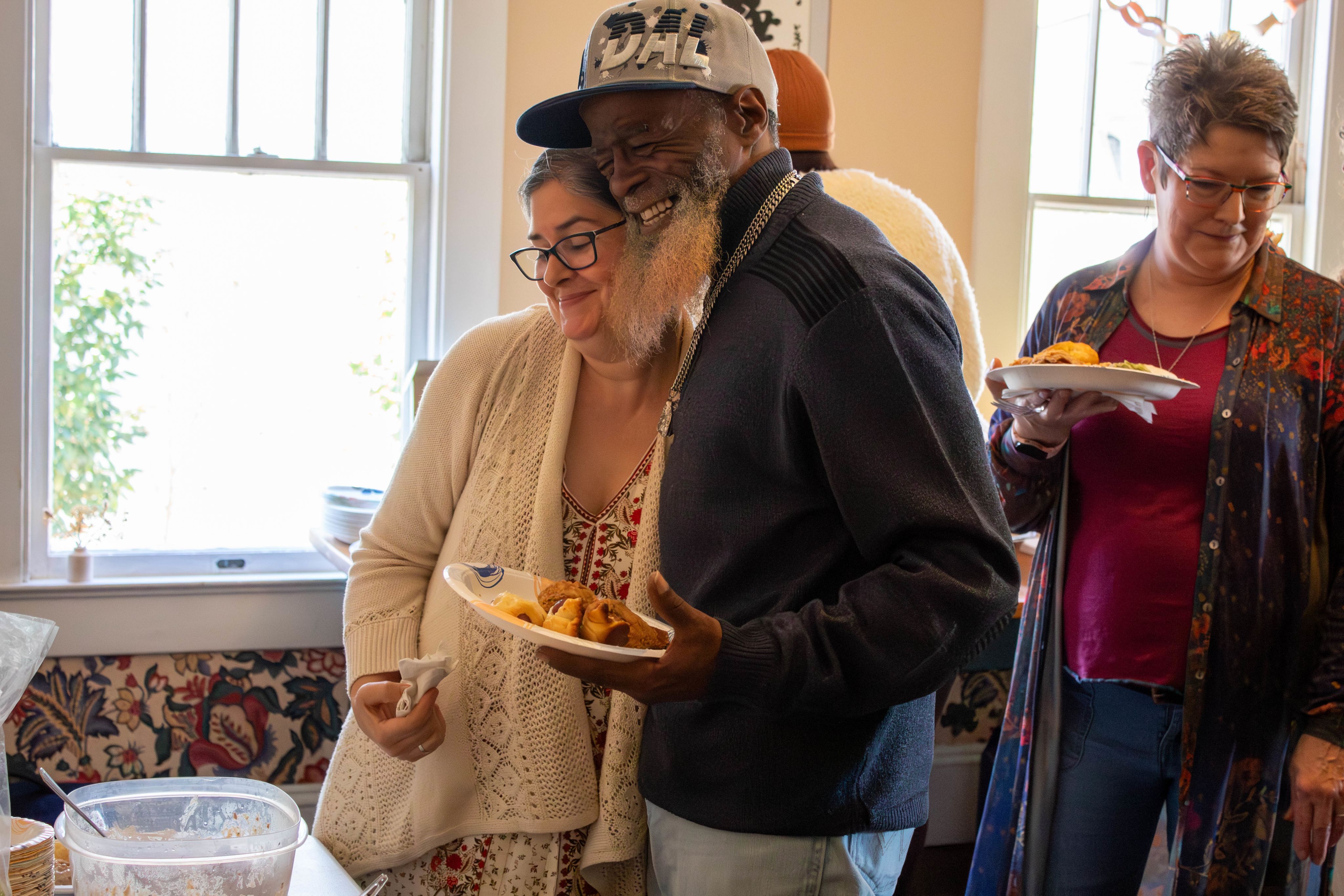
Thomas Clodefelter hugs Jennifer Nichols during the Triad Health Project's community gathering at Higher Ground. Photo by Nia Bedard.
Thomas Clodefelter hugs Jennifer Nichols during the Triad Health Project's community gathering at Higher Ground. Photo by Nia Bedard.
HIV is contracted through an exchange of bodily fluids, which can occur through having unprotected sex with someone positive, sharing needles, syringes or other drug injection equipment with someone positive, or through prenatal transmission.
A year prior to Clodefelter testing positive, the total number of AIDS cases in the United States of America reached 100,000.
But 45 years after the first reported cases of HIV/AIDS in the U.S., the fight against this disease is far from over, especially in the South.
According to the most recent data from the Centers for Disease Control and Prevention, the South accounted for 52% of all HIV diagnoses in the U.S. in 2023.
Professor of communication studies at Vanderbilt University Jeff Bennett said this high diagnosis rate stems from current systems in the South.
“We know that many more Black people live in the south,” Bennett said. “And we know that HIV/AIDS has had a disproportionate effect on people of color or queer people of color in this country, because you have all sorts of issues going on there. You have many people living in rural areas. You might have distrust of medical providers, you have the social stigma, you have the access question. There are so many different things to think about.”
The CDC reported 38,000 people received an HIV diagnosis in 2022. Men made up nearly 80% of new diagnoses in 2022. More men have also been diagnosed with HIV than women since 2008, according to the CDC. Men who reported male-to-male sexual contact are the population most affected by HIV, according to the CDC.
Bennett said that while non-straight men do make up a large portion of HIV diagnoses, HIV and AIDS affect all people.
“History sometimes tends to accentuate white gay people or cisgender white people,” Bennett said. “And it affected a lot of different people, and it hit, I think, communities of color particularly hard.”

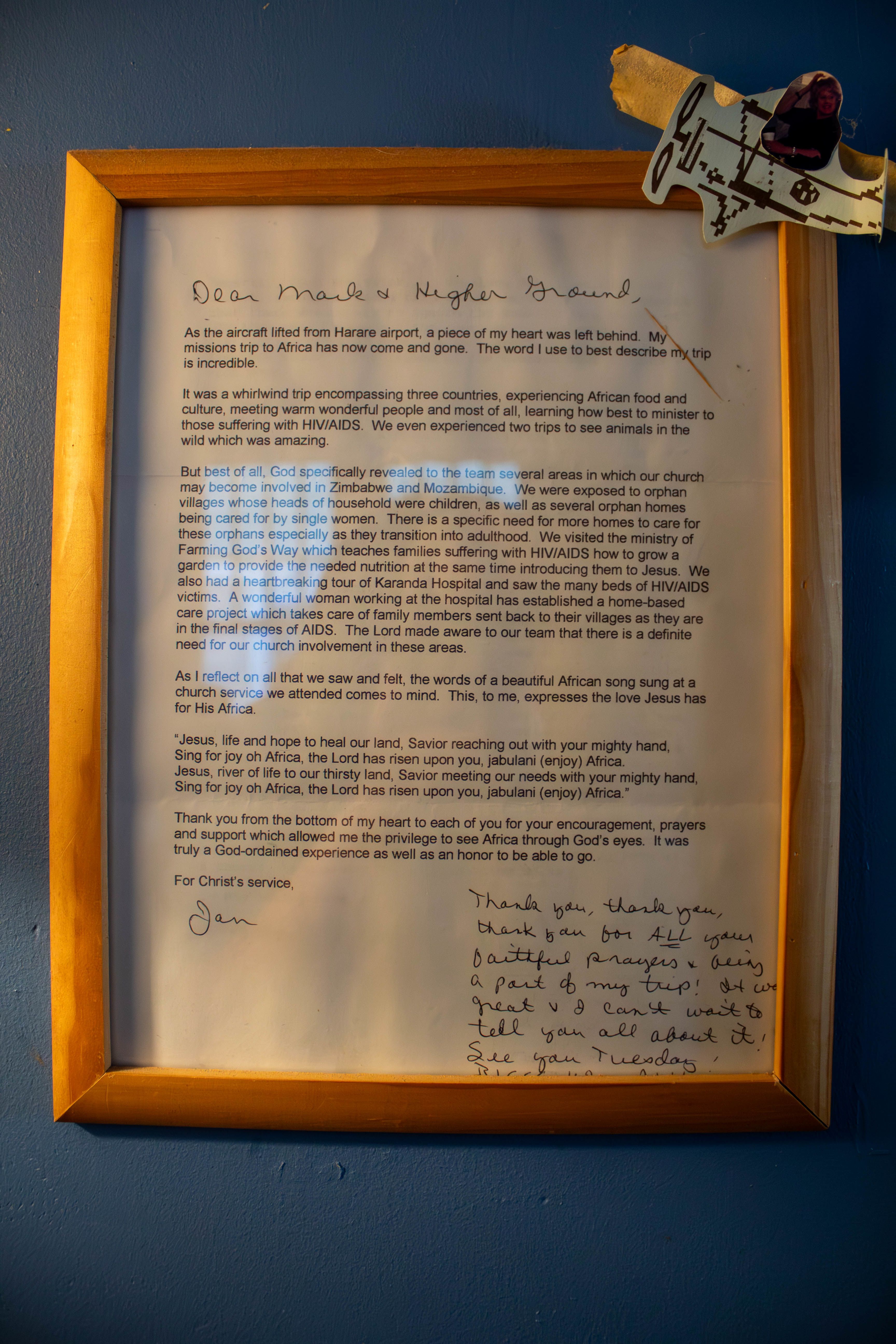
A letter hangs on the wall at Higher Ground on Nov. 17 detailing a missionary's experience treating people with HIV/AIDS in Africa. Photo by Nia Bedard.
A letter hangs on the wall at Higher Ground on Nov. 17 detailing a missionary's experience treating people with HIV/AIDS in Africa. Photo by Nia Bedard.
Black people also made up 38% of new diagnoses in 2023.
Clodefelter is a Black man who contracted HIV through his girlfriend at the time.
“So that was a new part of my life, the new as I call it, my new life after finding out, sat down for four years, went back to the street,” Clodefelter said. “I was really bad, not on medicine, I was going to treatment, but I refused the medicine.”
There is currently no cure for HIV. The primary method of treatment is antiretroviral therapy, which involves mixing two or more medicines from several classes of anti-HIV medicines.
“The political system, the medical system, these institutions really failed on a lot of levels, especially in the 1980s,” Bennett said. “Who really kind of had to push for the government to appropriate more money for these things, for medicine to conduct more drug trials, to push pharmaceutical companies to make those medications available.”
Marie Maher moved to North Carolina from New York in 1990 and has been living in Durham with her wife for 18 years. Maher said that during the '90s, people in the South knew about HIV and AIDS.
“People were aware of it, and depending on the person’s exposure and knowledge and stuff like that, there were different comments,” Maher said. “You know, like, ‘maybe they’ll kill themselves all off with this disease,’ and some were ‘what a terrible way to go.’”
While Maher said people in the South in the ‘90s were aware of the epidemic, in the present, she feels that may not be the case.
“AIDS is kind of forgotten about down here,” Maher said. “I mean myself included, unfortunately, just haven’t kept up with it, and you just don’t hear too much about it. And I don’t know how far we’ve come with drugs for treating it.”
Since the first case of HIV was reported in the U.S., more than 700,000 people have died from HIV and AIDS-related causes as of 2018, according to the NIH.
“HIV/AIDS just completely and radically transformed everything,” Bennett said. “A lot of those consequences were negative. When you have that many people who die of a virus, it’s just really hard to understand the sweep of what that kind of event does.”
Clodefelter said he has also noticed a current lack of public awareness of HIV/AIDS.
“How is it that we’re still educating people when there’s no education on TV?” Clodefelter said. “There’s none of the basics that we used to see when HIV first surfaced, when AIDS first surfaced. It’s like because we have the medicines now, treatment. Y’all have forgotten about the conversation piece.”
Dec. 1 is commemorated as World AIDS Day, which was created by the World Health Organization in 1988 to remember the millions of people who have died from HIV/AIDS-related illnesses.
In 2025, the United States did not commemorate World AIDS Day for the first time since 1988.
In addition to some feeling as though awareness of HIV/AIDS has decreased, Bennett said the stigmas surrounding the disease remain prevalent.
“I don’t know if the stigma has ever completely dissipated. The literature on hookup apps is pretty clear about this too, right? The number of people who say drug and disease free, or people who want to know if you are ‘clean,’” Bennett said. “It’s an interesting term, because, of course, the opposite of clean is dirty, right? And that’s basically what is imparted.”
Since testing positive, Clodefelter has been receiving treatment at the Triad Health Project, a nonprofit in Greensboro, North Carolina, aimed at slowing the spread of HIV and providing care to those with HIV.
“I hitchhiked to Greensboro,” Clodefelter said. “My mindset was not only to go in and receive case management and assistance, but also to be a part of this fight.”
Executive Director of the Triad Health Project Adriana Adams said her goal at THP is to give people with HIV/AIDS agency in their lives and autonomy by giving them access to medication and education.
Adams said the South having the largest amount of diagnoses in the U.S. is due to the lack of infrastructure.
“The South is poor, the South is more rural, the South has less infrastructure,” Adams said. “The South has people who are more stigmatized, and so they’re hiding it longer. They’re not going to the doctor to seek that care.”
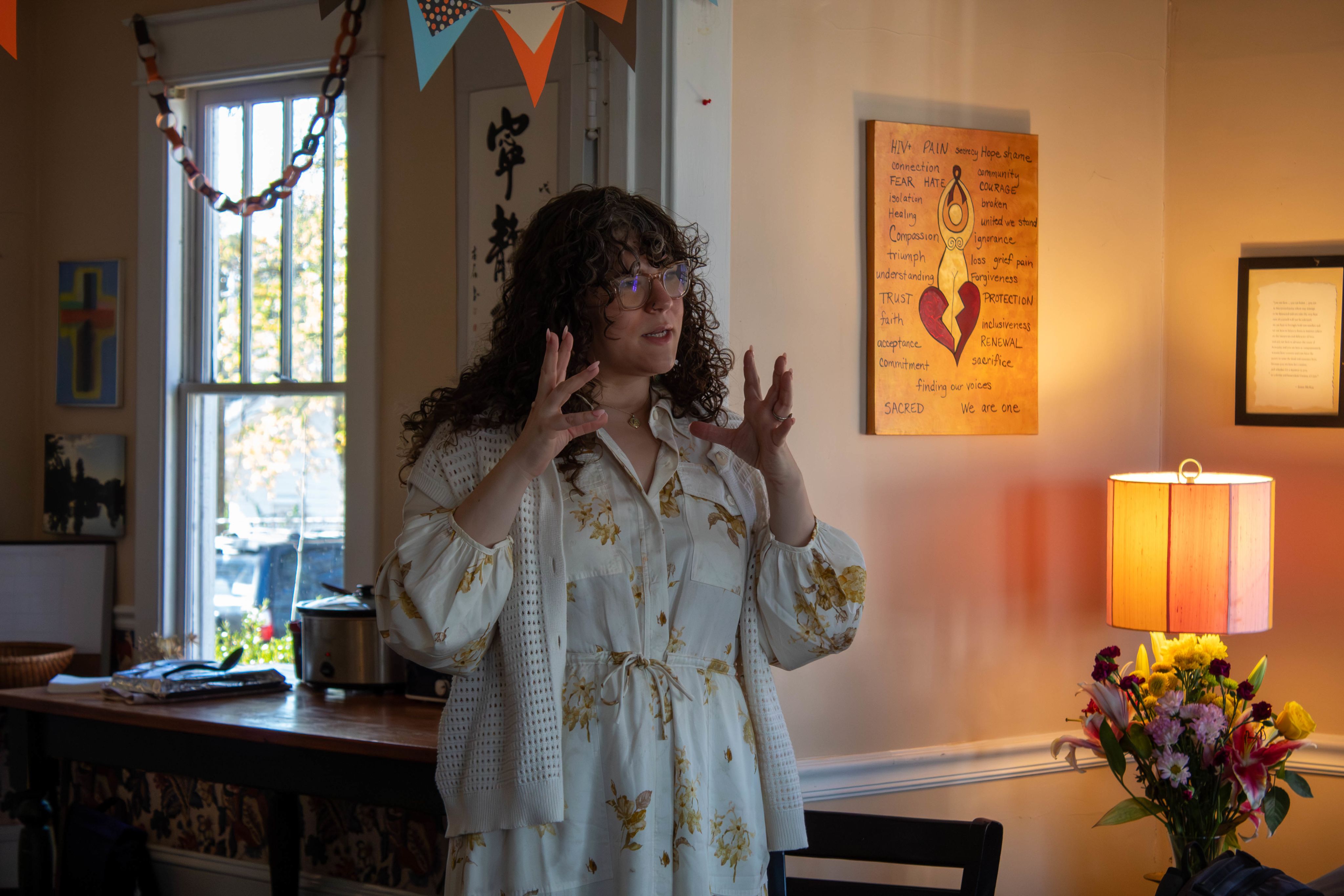
Executive Director for the Triad Health Project Adriana Adams speaks to team members during a community gathering at Higher Ground Nov. 17. Photo by Nia Bedard.
Executive Director for the Triad Health Project Adriana Adams speaks to team members during a community gathering at Higher Ground Nov. 17. Photo by Nia Bedard.
Since President Donald Trump has started his second term in office, Medicaid, a joint federal and state program that provides health coverage to low-income individuals and families, is set to lose $880 billion over 10 years due to cuts as a result of the signing of The One Big Beautiful Bill.
“We’re taking on clients from Winston-Salem, from Rockingham, from Alamance, because they don’t have those services anymore,” Adams said. “With the current cuts, they’re already shutting down. So who knows what’s going to happen in a year or two?”
The Commonwealth Fund, an organization focused on promoting a high-performing, equitable health care system, publishes scorecards comparing health care systems across the U.S. In the Commonwealth Fund’s 2025 Scorecard on state health system performance, 14 of the 17 states that the CDC considers part of the South are ranked negatively on the scorecard.
These states include Alabama, Arkansas, Florida, Georgia, Kentucky, Louisiana, Mississippi, North Carolina, Oklahoma, South Carolina, Tennessee, Texas and West Virginia.
The Community Wellness Liaison for THP, Cesar Velasquez Felipe, said nonprofits like THP are meant to serve those who can’t access health care for any reason such as finances or documentation.
“That’s the moment where community acts,” Felipe said. “There’s people who have and is living with HIV, they don’t have documentation, and they need treatment. So we people can’t wait for that. We need to be working to try to get them and try to support them, because that’s the goal.”
Felipe said stigmas surrounding HIV don’t just occur in the U.S.
“I grew up in a rural area in Mexico where I didn’t have any kind of resources,” Felipe said. “When I had my first experience for testing, it wasn’t the best. I felt a lot of shame, and I don’t want people to be there, so I’m trying to make the change by myself.”
Adams also said the stigmas around HIV/AIDS are still present today.
“There still is a lot of stigma that surrounds HIV,” Adams said. “There’s a lot of people out there who believe that there still is a death sentence that surrounds it, and then there’s people who just have that stigma that they kind of self-actualize.”
According to Adams, the stigmas around HIV/AIDS stem from how the virus can be transmitted.
“HIV is connected to sex in people’s minds, even though we know there’s other ways that people contract HIV, however, largely we know that transmission is through sex at a high rate,” Adams said. “That means that people think of HIV and sexuality and they link them together, and particularly here in the South, sex still carries a lot of connotations that are in the Bible Belt very much heavy for people, and are hard for them to get past, especially in a professional setting.”

A essay written about the Triad Health Project and the author's uncle, who had HIV/AIDS, hangs in Higher Ground. Photo by Nia Bedard.
A essay written about the Triad Health Project and the author's uncle, who had HIV/AIDS, hangs in Higher Ground. Photo by Nia Bedard.
Holly Racer, the lead case manager, said for THP the most highly diagnosed group is not just men who engage in sexual relations with other men.
“Our data tells us a certain story, especially with the most diagnosed, or the most highly diagnosed group being black women, Latina population, still the men sleeping with men. It’s been qualified in people’s minds as a gay related disease, and that’s not the case,” Racer said. “This is not just this one type of person that gets HIV.”
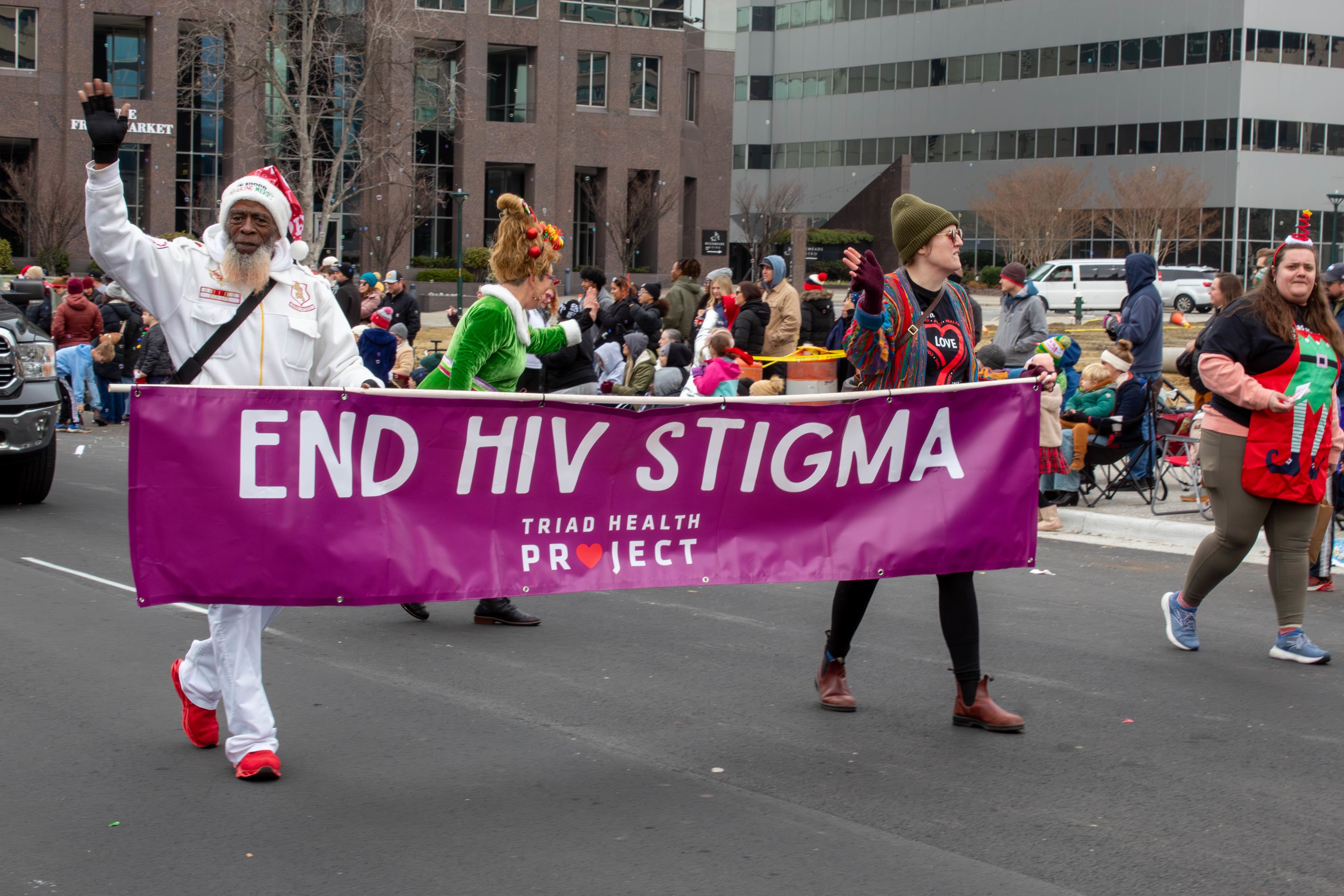
Thomas Clodefelter (left) and Holly Racer hold a banner and lead Triad Health Project's float during Greensboro's Holiday Parade on Dec. 6. Photo by Nia Bedard.
Thomas Clodefelter (left) and Holly Racer hold a banner and lead Triad Health Project's float during Greensboro's Holiday Parade on Dec. 6. Photo by Nia Bedard.
As Racer handles the case load for THP and no cure for HIV/AIDS exists, she said the best she can do for her clients is support them the best she can.
“It’s that sense of consistency and care and showing up that kind of makes me think, ‘Okay, today’s been successful,’” Racer said. “It’s those little, tiny steps for change or growth with a client, it becomes a lot more about that, or else we would be burnt out on both ends to try to figure out ‘Oh, can we accomplish everything?’ We can’t do everything, but we can do what we’re doing.”
re, what THP and other organizations like it can continue to do is educate others and continue to provide medication for those who are positive.
“I’ve made a promise,” Clodefelter said. “I made a promise to God that I wouldn’t ever stop talking. I wouldn’t ever stop educating. I wouldn’t ever stop being in the street passing out condoms, in the barber shops, in the salons, in the schools, wherever he wants, wherever he wants.”
 Built with Shorthand