
IN NEED OF REPAIR:
Thousands of North Carolina voters face extra steps to cast ballots in midterm elections
Almost 62,000 voters remain on the state’s voter registration repair list, including over 700 in Alamance County.
By: Charlotte Pfabe
When Gavin McGaughey helps people check their voter registrations, he doesn’t care if they are Democrats or Republicans, even if that means they may vote against him.
“Voter registrations are important, and making sure people can participate in the system is crucial and kind of bedrock to the whole thing,” McGaughey said.
Going door-to-door, Democratic candidate McGaughey introduced neighbors to North Carolina’s Voter Registration Repair list.
The database lists over 61,000 North Carolinians who are missing key identification information on their registration forms, such as driver’s license numbers or social security numbers. If these voters don’t cure their registrations, they won’t be able to vote regularly in November’s midterm elections.
Voters left on the list by Election Day — Nov. 3 — will need to vote using a provisional ballot, meaning their ballot isn’t automatically counted in night-of election results. The ballots are sent to the county board of elections, where officials verify details provided by the voter.
Then, the voter must still return to their local board of elections office within three business days to present their original identifying documents to cure their ballot, or they can complete a Photo ID exception form at their voting site. Without that final step, their vote won’t count.
In the March primary elections, NCSBE data shows 84 provisional ballots cast in Alamance County, with 8,797 provisional ballots cast statewide.
“Provisional ballots are a lot of paperwork. It'll take a lot longer to vote,” said Dawn Hurdle, director of the Alamance County Board of Elections. “So it's a lot easier to have it go in, vote on the machine, and walk out, and your vote's done.”
The North Carolina State Board of Elections launched the list in July 2025, mailing out notices to affected voters twice – once in August 2025 and again this September.
But, McGaughey said of the people he spoke to, most didn’t know their registrations were incomplete, and they didn’t know how to fix them.
How does a voter end up on the list?
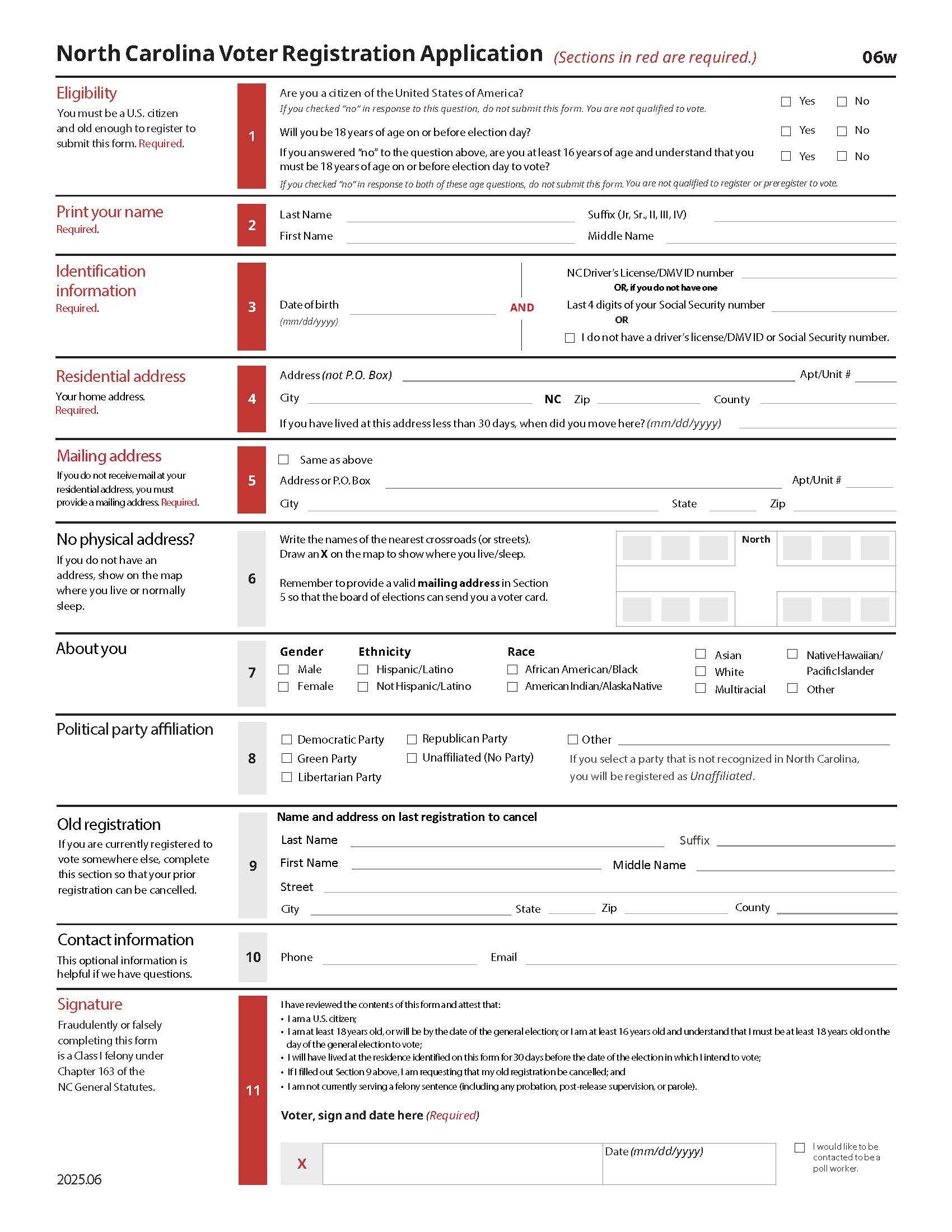
A mistake on some state voter registration forms led many voters to turn in incomplete registrations.
For around a decade, the instructions on certain North Carolina registration forms didn’t require voters to add identification numbers, which meant thousands of voters registered incorrectly, according to the NCSBE.
In North Carolina, every voter must provide one of three identifying numbers,
North Carolina driver’s license number, DMV ID number or the last four digits of their social security number.
Then, those numbers are cross-referenced with records from North Carolina’s Drivers Division of Motor Vehicles or the Social Security Administration, according to Hurdle. If information on a registration doesn’t validate, or is missing, it is added to the repair list.
“Even a couple years ago, box three, where people put their last four, their social, or their driver's license number, that was an optional field,” said Caitlin Metzguer, deputy state director of Common Cause North Carolina, a national nonpartisan organization focused on protecting the elections process.
The NCSBE corrected the form in January 2024, requiring identification numbers to be added. The state added any voter who registered prior to the correction to the repair list.
“I think people end up on the list and they're surprised about it because many of these people registered decades ago and have no memory of the form or if they included that or if they didn't include that,” Metzguer said.
But, not every voter on the list is missing identifying information. Some forms were simply filled out incorrectly, often with mistakes in addresses or birthdays, according Hurdle.
She said everything on a voter’s registration form must match their official identifying documents to verify. Each board of elections office is linked to databases from the DMV and Social Security.
Hurdle said the issues can be as simple as switching a few numbers around or, out of habit, writing their birthday using the current year rather than their birth year.
According to data from the NCSBE updated Oct. 10, 121,597 people are registered to vote in Alamance County.
As of Oct. 18, 757 Alamance County voters are listed in the repair database and are all marked inactive on state voter rolls.
While that number may seem small in comparison to the total number of registered voters, Jason Tyson, the NCSBE’s director of external affairs, said a single vote can decide an election in a swing state like North Carolina. He pointed to the Republican primary race for North Carolina State Senate between Rockingham County Sheriff Sam Page and Senate President Phil Berger.
Page won by 23 votes.
“It just shows you that there's fine margins in some areas in North Carolina,” Tyson said.
No registered voters were removed from voter rolls, according to statements released by the NCSBE. Tyson said the NCSBE hopes the repair list tightens election security and efficacy.
“That's one of the reasons why we sort of wanted this information,” Tyson said. “We're making it easy to vote and hard to cheat.”
But efforts to strengthen election security do not outweigh the burden placed on voters, according to Dreama Caldwell, executive co-director of Down Home NC, a nonpartisan organization focused on mobilizing working class communities in rural North Carolina.
“We're making it easy to vote and hard to cheat.”
- Jason Tyson-
Director of External Affairs for North Carolina's State Board of Elections
“The goalpost is constantly being moved for working class folks."
Members of Down Home NC traveled around the state and called voters, sharing information about the repair list and how to fix the errors, Caldwell said.
She said the list is one of several changes to the elections system that confuses voters. She pointed to changes for people with prior felony convictions to vote.
In 2022, the North Carolina Court of Appeals ruled that a previous North Carolina law, N.C.G.S. 13-1, which barred people with prior felony convictions from voting, was unconstitutional. Therefore, more than 55,000 formerly incarcerated people were eligible to vote in the 2022 midterm.
However, when the case, Community Success Initiative v. Moore, made its way to North Carolina’s Supreme Court in 2023, the justices overturned the lower court’s ruling, revoking those voting rights.
“When working class people get to the polls, they believe that their votes are going to count,” Caldwell said. “They believe that what they are doing is the right thing, and then later on find out something else different. It's confusing to folks who just can't keep up with the changes.”

Counties not considered rural are marked yellow. 78 of North Carolina's 100 counties are considered rural according to NC Rural Center.
Counties not considered rural are marked yellow. 78 of North Carolina's 100 counties are considered rural according to NC Rural Center.
Counties not considered rural are marked yellow. 78 of North Carolina's 100 counties are considered rural according to NC Rural Center.
Counties not considered rural are marked yellow. 78 of North Carolina's 100 counties are considered rural according to NC Rural Center.
Counties not considered rural are marked yellow. 78 of North Carolina's 100 counties are considered rural according to NC Rural Center.
Counties not considered rural are marked yellow. 78 of North Carolina's 100 counties are considered rural according to NC Rural Center.

Counties not considered rural are marked yellow. 78 of North Carolina's 100 counties are considered rural according to NC Rural Center.
Counties not considered rural are marked yellow. 78 of North Carolina's 100 counties are considered rural according to NC Rural Center.
The case of voter rolls for rural North Carolina
For McGaughey, the list highlights barriers he’s seen in rural communities his whole life.
McGaughey was born and raised in Rockingham County, where communities are tight-knit, but spread out. When he was out with the canvassing team, he said some houses were 10 minutes apart, a stark contrast to more populated areas like Raleigh.
“There's a lot of older folks out here, particularly who get their news from television and they scroll Facebook, but most of their interactions are with people at a local pharmacy or at a convenience store. So they're not necessarily hearing, ‘Hey, your voter registration may need to be updated,’” McGaughey said.
According to NC Rural Center, 78 of North Carolina’s 100 counties are rural, including Rockingham County. The center considers counties rural if there are 250 people or fewer per square mile living there.
Alamance County is considered suburban.
Speaking directly with voters on this list, McGaughey said many people didn’t know about the issues with their registrations or the state-wide changes. He said he had to assure the voter that they didn’t do anything wrong.
“Some people have lived at the same address for 30 years, and now all of a sudden they're told ‘You can't vote unless you update your voter registration,’” McGaughey said. “So for most people, it was just confusion because when they had registered, there were certain requirements today that didn't exist at the time.”
Down Home NC’s mission focuses on rural voters. Caldwell said there are still some places where internet access is limited, meaning all voters don’t have the same levels of access.
“There are still homes that don't have internet. There are still homes that don't have computers, believe it or not. And so those folks should not lose what is their right to vote because they don't have access to those resources,” Caldwell said.
According to 2024 U.S. Census Data, 73,880 households make up Alamance County. Of those households, 7.3% lack internet access.
Caldwell said working class voters are disproportionately affected by the voter roll changes. Boards of elections are often open during normal business hours, meaning many voters need to take time off work to correct their registration.
“In rural areas where we work, people may live miles away from the board of elections,” Caldwell said. “Transportation can be an issue. Working hours may be the same hours as the board of election, and so those things make it hard.”
Metzguer said Common Cause NC helps voters print registration documents and collaborates with local election boards to host registration events. She said smaller communities often interact more with their election boards.
“I do think there is more familiarity, in my experience, with the Board of Elections in more rural areas,” Metzguer said, “and that I think is because people generally have lived there longer and maybe just know more people in the community, as opposed to the more populated areas.”
“Only the people who show up get to make decisions, and I just want everybody to have the capacity to show up."
Ron Osbourne used to work as an official poll worker with the Alamance County Board of Elections. Now, he serves as the chair of the Alamance County Democratic Party.
With the ACDP, Osbourne called voters to share registration information.
“I know I talked to a couple of people that were Republicans, and they're like, "Why is the Democratic Party calling me about my vote?” Osbourne said. “And we just we told them, said, ‘We want everybody to be able to vote.’”
In Rockingham County, party differences also affected McGaughey’s efforts. He quickly learned to adjust his introduction.
“When you knock on the door and you say, ‘Hi, my name is ‘insert’ with the Rockham County Democratic Party, and we're trying to come out;’ some people just shut the door,” McGaughey said. “They don't want to listen to anything after that.”
McGaughey said he doesn’t care if the people he helped vote for him because more voter representation means fairer elections.
“Only the people who show up get to make decisions, and I just want everybody to have the capacity to show up," McGaughey said.
A cure for a case of registration repair
The NCSBE is making progress getting voters off of the list, Tyson said.
When North Carolina launched the list in 2025, around 103,000 voters needed to validate their registrations. As of Oct. 18, 62,214 voters make up the database, a decrease of about 40%.
North Carolina’s registration deadline was Oct. 9, meaning unregistered voters wishing to vote in the November midterms must register same-day during the early voting period from Oct. 15 to Oct. 31.
Prior to the registration deadline, voters on the list had three options: update their registration through the NCDMV’s website, visit their county board of elections office in person, or fill out the letter sent from the NCSBE and mail it back to their county board of elections office.
“There was additional mailings that went out twice since the primary, and if those voters do not get the letter back to us by the registration deadline, then when they go to vote, they will have to vote a provisional ballot,” Hurdle said.
Hurdle said unlike mail-in ballots, which must be postmarked by a certain date, the mailed registration needed to physically arrive at the board of elections by Oct. 9.
Voters can check if their registration was received and processed by visiting the NCSBE website.
Voters with a North Carolina driver’s license or DMV ID number could also update their registrations for free through the NCDMV’s website.
With the exception of updating registrations through the NCDMV, all voter registration forms needed to be physically signed by the voter, meaning a voter had to print out the paperwork themselves.
“We have to have a wet signature,” Hurdle said. “It cannot be a digital signature except through the DMV.”
If a voter shows up to the polls on Election Day and votes using a provisional ballot, Hurdle said their identification information will be paired with their registration moving forward if it’s validated by the board of elections. Then, they will be removed from the list.
Until Oct. 31, the only option for voters to register is to complete same-day registration at early voting locations. However, voters with invalid registrations would still need to vote using a provisional ballot.
The NCSBE provides a database to check the status of a provisional ballot, which is updated at least 10 days after the date of the election.
 Built with Shorthand