Clipping the South's wisteria problem
It's beautiful, it's invasive and there's no law stopping it. Ecologists and activists are trying anyway.
Sam Wright kneels at the base of a tree, just where the woods thin out along the edge of the Oak Crest neighborhood. The line between property and forest is blurred here, somewhere along the border of Chatham and Orange County — and thick with rolling waves of wisteria.
With clippers in one hand and a small bottle of herbicide in the other, Wright works slowly, deliberately. He snips wiry vines, pulls stems free and traces each one back to its root. The process is meticulous. A wrong cut or a misplaced drop of herbicide could damage the native plants beginning to re-emerge beneath the tangle.
Wright is the founder of EcoGuy Ecological Consulting, a small operation focused on habitat restoration and invasive species removal across central North Carolina. Work like this — slow, physical, tucked away in hard-to-reach spots — is the core of what he does.
“When it’s really thick and dense, it kind of seems impossible,” he said, pausing to wipe his hands. “But I know it can be done.”
Wright explains how he removes larger wisteria vines from trees on April 5 in Chapel Hill. Video by Catherine Smith
From the street, the contrast is visible: one stretch of land still swallowed by dense green vines, another where Wright has already worked, now open and breathing.
In the restored section, sunlight filters through young trees. Bees hum. Butterflies drift between native plants that have returned on their own, emerging from a long-buried seedbank. The recovery has been so successful that New Hope Bird Alliance awarded the site a Bird-Friendly Habitat Certification. Over 40 native species have returned to the area and flourished.
“That’s without planting even one plant,” he says, gesturing to the storybook-esque slice of land. The seed bank, nature’s storage of viable seeds hidden in the soil, has been freed from the vines.
Just a few yards away, the difference is stark. And it’s all over the American Southeast.
Roadsides nationwide look like this area, choked with wisteria vines. This zone is right next to Wright's rehabilitated habitat zone.
This clear, grassy area is just a few yards away and has been restored via wisteria removal.
Into the thick of it
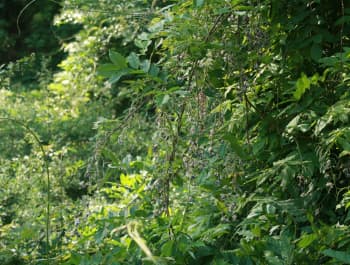
Wisteria — thick, coiling, relentless — climbs and constricts everything in its path. In the densest patches, little else survives. The canopy chokes out light. The forest floor falls silent. Tree trunks bear deep grooves where vines have tightened over time, cutting into bark slowly like painful, living ropes.
Ropes of wisteria wind around a tree in Chapel Hill on April 5. Photo by Catherine Smith
Ropes of wisteria wind around a tree in Chapel Hill on April 5. Photo by Catherine Smith
“The vines just jump up these trees. They look a little scrappy. I kinda joke that this is my forest of misfit trees.”
- Sam Wright
Wright points to a deep groove in a tree from which he removed a large wisteria vine on April 5. Photo by Catherine Smith.
Wright points to a deep groove in a tree from which he removed a large wisteria vine on April 5. Photo by Catherine Smith.
Scarring is just one less-than-lovely side of a plant many in the South associate with beauty. Wisteria has been part of Southern landscapes for generations, draped over porches and woven into garden trellises. Its lavender blooms are a seasonal marker, as familiar as dogwoods in spring.
“It’s been in the South for 200 years,” said David Vandermast, a professor of biology at Elon University. “So it feels native, but it’s not.”
Ecologists say that perception masks a deeper problem.
“Like most invasive species, it’s outcompeting native plants,” said Amanda Chunco, a professor of environmental science at Elon. “Most of our trees are important host plants for butterflies and bees and all kinds of birds, so it's hurting the base of the food chain.”
Most species of wisteria in North Carolina are nonnative and highly invasive. Without natural checks, they spread aggressively, overtaking forests, suppressing biodiversity, and weakening the ecosystems that native species depend on.
“Oak trees host something like 300 species of insects,” said Chunco. “If you lose that oak tree, you lose that habitat, and not much else grows.”
The problem extends beyond any one plant. The persistence of invasive species like wisteria is tied to broader systems — from the continued sale of nonnative ornamentals by large retailers, to gaps in public education about native planting, to land-use histories rooted in agriculture and clear-cutting. In rural areas, access to restoration resources and ecological guidance can be limited.
“There’s lots of rural areas where people care a lot about wildlife, but maybe don’t have the economic resources or infrastructure to give up a work day,” said Chunco, who volunteers in Hillsboro with a local group clearing kudzu and wisteria.
North Carolina provides voluntary programs for private landowners to manage invasive plants through the NC Forest Service. They typically require landowners to apply for funding that covers up to 75% of costs through the Environmental Quality Incentives Program. But these programs often aren’t well-known in rural areas, and can rack up an expensive bill. What remains, often, is the work of individuals.
Advocates, landowners, and restoration specialists like Wright take on the labor-intensive process of undoing decades — sometimes centuries — of ecological imbalance.
The physical work is slow and sometimes invisible. Unless you know where to look.
Wright's method is humble, yet ruthless on the invasive vines. He's spent over 400 hours clipping wisteria in Chapel Hill.
How we got wound in wisteria
Professor David Vandermast scrolls through iNaturalist in his Elon University office, dragging his finger across a map dotted with orange — each one a confirmed wisteria sighting. The dots cluster heavily in the Southeast, but stretch as far as Nebraska and Maine. He points to a cluster in the Northeast, then one in Florida.
"If it's growing up here in Maine in seriously cold winters, it doesn't care," the plant ecologist said. "And if it's growing down here in Florida with it being seriously hot and humid, it doesn't care."
Click to explore the worldwide Chinese wisteria map on iNaturalist.
Wisteria is a generalist species, tolerating most temperature ranges, soil qualities, and nutrient conditions. Its Chinese and Japanese varieties were introduced to the United States between 1816 and 1830 for their lush purple flowers, heady fragrance, and ease of planting — arriving at a moment when moving ornamental plants between continents was completely unregulated and poorly understood. It's the same story as kudzu, English ivy, and Bradford pear.
In the spring, wisteria is undeniably stunning. Wright calls the attraction to wisteria “green blindness.”
“Green is beautiful, then you have green and purple, and that’s beautiful too,” he said. “And so, I think the perception is like, ‘Why are you getting rid of that?”
But the bloom only lasts so long. When it ends, wisteria goes back to looking like any other vine.
“It’s only pretty for two weeks a year, then you’re left with a mess,” Wright said. “I would say it’s prettier to have 20 native species than one thriving nonnative.”
Sam Wright looks out over acres of land covered in wisteria, a "mess" and tangle of vines after peak bloom on April 5. Photo by Catherine Smith.
Sam Wright looks out over acres of land covered in wisteria, a "mess" and tangle of vines after peak bloom on April 5. Photo by Catherine Smith.
After blooming, the vine spreads while blending in. Its underground root system fans out horizontally, sending up new shoots far from the original plant.
"Once the flowers go away, it's not as dramatic, but it's still there," said Amanda Chunco, a wildlife ecologist who has brought several of her Elon honors classes to local forests to remove wisteria. "It's all green leaves, and it's photosynthesizing and growing and building the vines and doing its thing. It just blends in better with the trees."
Above ground, its seed pods pop like a slingshot — a process called ballistic dispersal, also found in witch hazel and violets — launching seeds up to 30 feet from the parent plant.
“The water pressure builds up and it just explodes,” Vandermast said. “Sometimes you’ll be out in the woods, and you’ll hear this pop, and you know that’s a wisteria pod that has exploded.”
Sam Wright details his experience seeing and hearing ballistic dispersal in the forest on April 5. Video by Catherine Smith.
The plant’s aggressive reproduction methods make it incredibly difficult to accurately map how much of the country it covers. Wisteria avoids its own competitors, seeding into open ground ahead of its current edge. It explains why it so reliably follows highways and roadsides, pushing further into the landscape with each season.
Power lines can sag dangerously from their weight. It can creep into septic systems underground or tear home siding clean off.
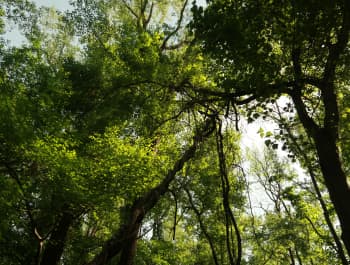
The one environment that slows it down is the one North Carolina has the least of: deep, dark, old-growth forest, where the canopy is thick enough to block the light wisteria needs to climb.
"In this country, we don't let land sit undisturbed for the 150 or 200 years it takes to get an old-growth forest. A real old-growth forest is shady, it's cool."
- Amanda Chunco
North Carolina's forests are predominantly second-growth — logged and cleared through the 19th and 20th centuries for agriculture and timber, then left to recover. What grew back is younger, more open, and far more penetrable than the old-growth forest it replaced.
Over 54% of North Carolina is covered by forests. Less than 1% are in old-growth condition, according to an article from WRAL.
"I don't think there's anything in North Carolina beyond brackish water that's going to keep it from going pretty much anywhere it can get to," Vandermast said.
All wrapped up in retail
Not only does wisteria find the landscape hospitable — it finds the marketplace welcoming too. A Chinese wisteria seedling sells for $19.99 on Amazon. Big-box retailers carry it with no warnings and no legal consequences.
The horticulture industry has long favored non-native plants for their showiness, ease of cultivation, and reliable commercial appeal. Customers rarely know they're buying something their local ecosystem cannot use.
“I think unless we legislate things, market forces don’t work,” said Chunco. “A lot of invasive plants are prettier than native plants, and that’s why they’re sold still.”
North Carolina native Angela Gaskell calls Tractor Supply, one of the nation’s leading plant retailers, every season – doing what she calls “nagging.”
“Some people would just write back and say, ‘Hey, we’ll look into this,’” she said. “But there’s never any effort.”
Gaskell is the statewide coordinator for the Prescribed Burn Association and helps private landowners manage their forests with fire. But wisteria’s underground vine system keeps it immune to burning. And Gaskell is tired of seeing the climbing tendrils she describes as a “nuisance.”
“We don’t have it illegal yet in North Carolina, which would be a huge jump forward, because we have such a great environment to grow these plants,” she said. “We have great soils and water and air, so they just take over like the kudzu.”
The legal landscape offers little pressure to change that. The United States has no federal law prohibiting the sale or planting of wisteria. Invasive varieties of the vine are illegal in over a dozen states, according to National Geographic.
But these plant regulations vary by state and are broadly weak — a gap that has contributed to crises well beyond wisteria. Removal is rarely required unless there is an imminent infrastructure risk, like vines pulling down a power line. Even then, it is the utility company or private group — not any government agency — that acts.
“I just wish that we could educate and learn and maybe set some precedent that we have to get ahead of this species,” said Gaskell. “It’s probably near impossible to eradicate it at this point.”
It’s biologically equipped to spread, commercially incentivized to sell, legally unencumbered, and widely beloved — a combination that Jack Kalil, an Elon University student and native plant enthusiast, finds quietly maddening. He points to the ornamental shrubs lining the edges of Elon's campus: pink flowers, attractive, low-maintenance. And completely silent.
"Look at those bushes," he said. "Notice how there are no bees."
Native plants, he said, are never that quiet. The difference between a landscape that supports local wildlife and one that merely resembles it is audible, if you know to listen for it.
Jack Kalil tends to his native plant collection in the Elon University greenhouse on April 16. Photo by Catherine Smith.
Jack Kalil tends to his native plant collection in the Elon University greenhouse on April 16. Photo by Catherine Smith.
In Kalil’s eyes, plants aren't meant to be silent.
Clipping back, one vine at a time
The tools are humble. A hand clipper. A daubing brush loaded with herbicide.
Wright's hand tools in the grass near his Chapel Hill habitat zone on April 5. Photo by Catherine Smith.
Wright's hand tools in the grass near his Chapel Hill habitat zone on April 5. Photo by Catherine Smith.
Sam Wright has done this long enough to know there is no elegant solution to wisteria. You find the vine at its base, cut it, and treat the stump before it can resprout. Then you move six inches down the tree and do it again. You reclaim the area, rather than treating it.
Amanda Chunco brings her students with her. Several of her honors classes at Elon University have spent time in local forests pulling and clipping wisteria alongside her, learning to identify what belongs and what doesn't, and why the difference matters.
“The student reflections they wrote for their final were just beautiful, about how impactful it was,” she said.
Sam's upcoming community removal event in Chapel Hill will open that experience further — to volunteers, students, families, professionals, anyone willing to show up with gloves and a few hours. The work itself, those who do it consistently say, has a way of giving back.
Individual removal, however necessary, is not enough on its own. Angela Gaskell knows this. She has spent years pushing for something more structural: regulations that treat the sale of invasive plants with the same seriousness as plants that are toxic to people.
“The first step is to make a law to ban it and not have people sell or trade it,” she said. “And the second part is, what do we do with what exists right now?”
Ecological professionals don’t know for certain. But the educational pipeline is part of the problem too. Chunco's daughter comes home from elementary school with thirty minutes of science instruction a day.
“We don’t have much science education in schools, and most of what we do have is not focused on ecology or sustainability,” Chunco said. “I am frustrated with the public system in general.”
Jack Kalil came to native plants from a lifelong love of orchid gardening. What he returns to, again and again, is something that sounds almost too simple: working with plants is good for you. Not just for the land.
"It's restorative," he said. “One time, I sat in the greenhouse and just watched a bee fall asleep in a flower, and it’s just really cool how the wildlife will come back out of nowhere if you have the right plants.”
On a recent afternoon in Chapel Hill, Sam Wright was mid-removal when a neighbor came down the path with two dogs. She looked over at what he was doing. She smiled.
"Thank you," she said, and kept walking.
Sam kept working. Above him, something moved in the canopy — a shift in the leaves, the flutter of wings. The birds were still chirping. In the underbrush, something buzzed. The bees were still there.
This is the inverse of what invasive plants do. Wisteria arrives and the buzzing stops, the specialist insects disappear, the birds that depend on them follow. Native plants return and the opposite happens — the forest fills back in, not just with vegetation, but with sound. With life that belongs there.
Sam had been working on this site long enough to have seen it change. He remembered the day he rounded a bend in the trail and stopped cold.
There, tucked into a recovered patch, was a monkeyflower — a native wildflower, delicate and purple-throated, the kind that had no business being there unless the ground beneath it had healed enough to let it grow. And hovering at its lip, wings a blur, was a hummingbird.
“Because of the wisteria, it hadn’t been able to flourish, and the hummingbird wouldn’t have any food,” he said. “But it had come back, and I was so damn excited. It was like a fist bump to myself.”
The hummingbird moved on. Sam went back to work.
And the forest wasn't so silent anymore.
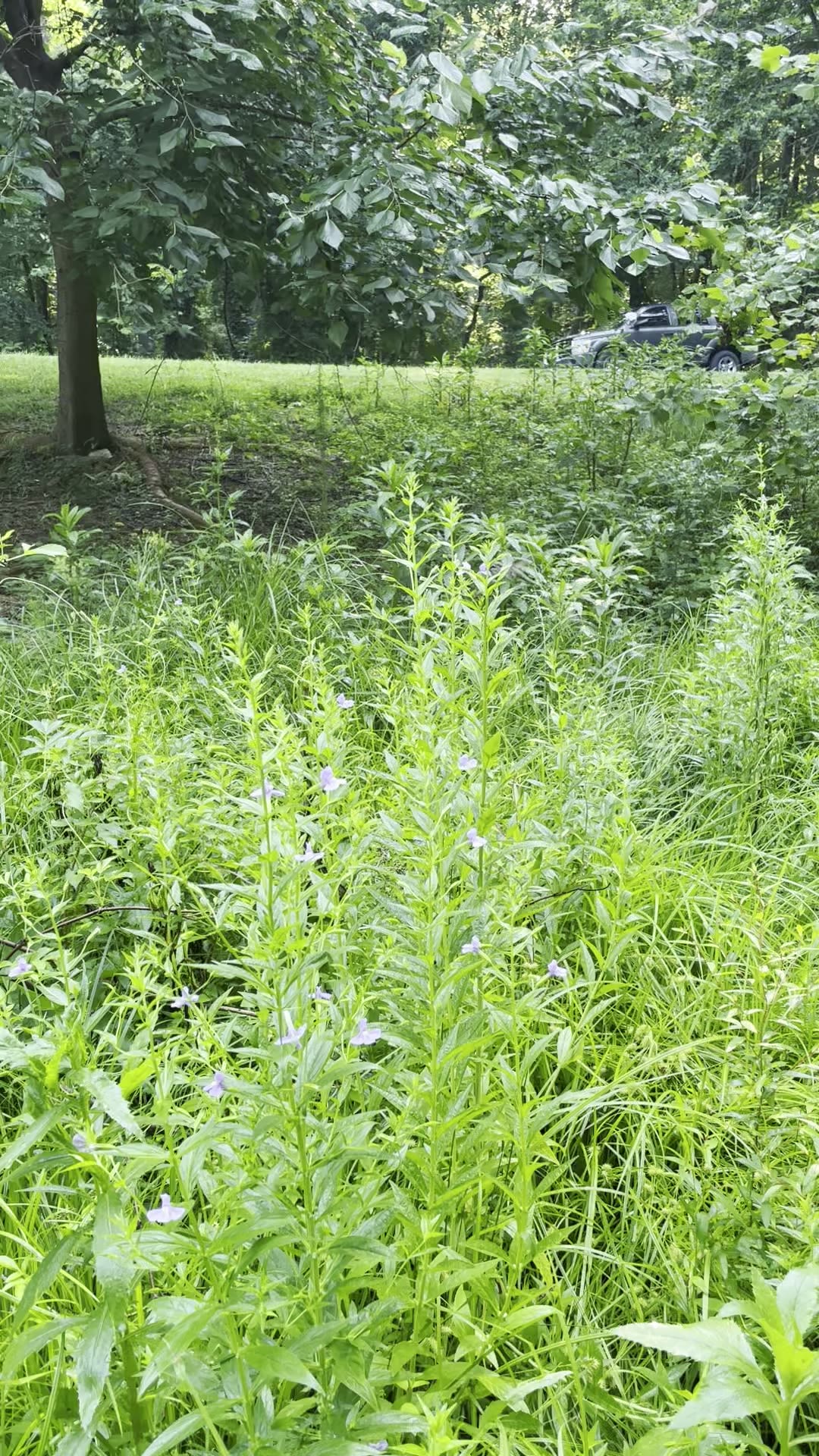
The moment Sam Wright saw a hummingbird return to the habitat restoration zone in Chapel Hill in 2025. Courtesy of Sam Wright.
The moment Sam Wright saw a hummingbird return to the habitat restoration zone in Chapel Hill in 2025. Courtesy of Sam Wright.
 Built with Shorthand